Natural-Processed Coffee: What It Is, Why Producers Choose It, and What It Tastes Like
Natural-processed coffee dries inside the whole coffee cherry. Learn how the method works, why producers choose it, and why it often tastes sweet, fruit-forward, and full-bodied, with Gitesi Natural and Lensa Gari as examples.

Natural-processed coffee begins with the most straightforward idea in coffee processing: after harvest, the whole coffee cherry dries around its seed.
That is why natural coffees can taste so different from washed coffees. In a washed process, most fruit is removed before drying. In a natural process, the fruit, skin, and seed stay together for the entire drying stage. The seed remains inside the cherry while sugars and fruit compounds shape the path to the final cup.
This is the final article in our three-part series on coffee processing. Part one explored washed coffee, where fruit is removed before drying. Part two looked at honey processing, where some sticky fruit mucilage remains. Natural processing takes the fruit connection furthest: the coffee dries inside the complete cherry.
None of these methods is automatically better than the others. They are different choices, made by producers in response to their coffee, their climate, their equipment, and the kind of cup they want to create.
What is natural-processed coffee, and how is it processed?
A coffee cherry is a fruit. Beneath its skin are pulp and sticky mucilage, and inside those layers sit the seeds we call coffee beans. With natural processing, those layers stay in place while the cherry dries.
The word natural can be misleading. It does not mean the coffee is organically certified, and it definitely does not mean nobody has worked on it. A well-made natural coffee is the result of careful daily work.
The broad process usually follows these stages:
- Picking and sorting: Producers begin with ripe, healthy cherries. Because the entire fruit will dry around the seed, quality selection matters from the start. Damaged, under-ripe, or overripe fruit can create problems if it stays in the lot.
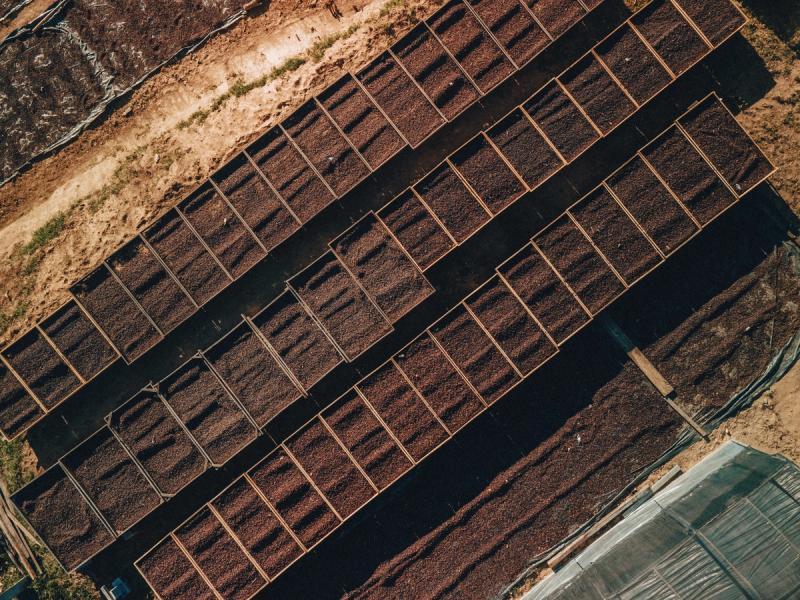
- Spreading the cherries: Whole cherries are laid out to dry, often on raised beds or patios. They are usually kept in controlled layers rather than piled up, so air can move around them.
- Turning and monitoring: The cherries are moved regularly to support even drying and to give workers a chance to check for fruit that needs to be removed. The rhythm depends on the weather, the drying surface, the thickness of the layer, and the condition of the cherries.
- Slow drying: Over days or weeks, water leaves the fruit and the seed inside it. The cherry darkens, shrivels, and eventually becomes dry enough for the coffee to rest safely.
- Milling: Later, the dried fruit skin and parchment are removed to reveal the green coffee seed that will be roasted.
It sounds simple because the fruit stays on. It is not simple in practice. The drying stage needs space, airflow, suitable weather, and regular attention. Natural processing is not about leaving cherries alone in the sun. It is about guiding a slow process closely enough that the fruit contributes sweetness and complexity without introducing defects.
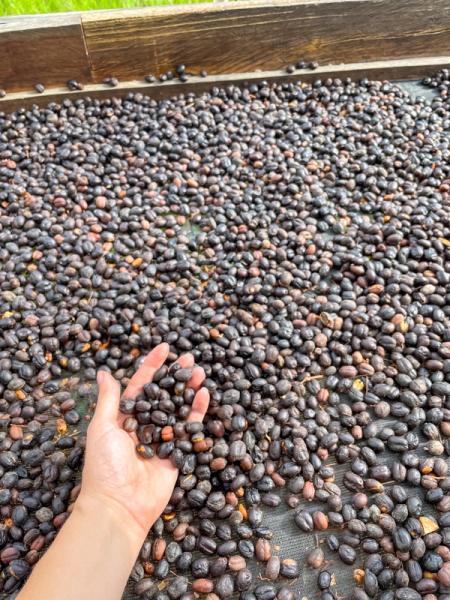
Photo below: Drying an anaerobic natural at Dariela Mancía’s Finca El Mandarino.
Why do producers choose natural processing?
Natural processing gives producers a direct way to keep the character of the cherry involved for longer. While the fruit dries around the seed, it can support a profile with deeper sweetness, fuller texture, and generous fruit notes.
For a producer, that can be an exciting creative tool. A natural process can make berry, tropical-fruit, wine-like, or jammy qualities more prominent, depending on the coffee and how it is managed. It can also give a particular variety or place a more expressive voice in the cup.
The method is demanding in a different way from washed or honey processing. It calls for drying space and steady labour. Cherries need to be turned, watched, protected when conditions change, and sorted with care. The details matter because drying too slowly, too quickly, or unevenly can change the outcome dramatically.
Weather plays a particularly visible role. Dry, stable conditions can make it easier to manage a natural process, while rain or high humidity may require more careful planning and protection. That is why the best natural coffees are never just “sun-dried.” They are the result of people reading conditions, responding to them, and making decisions every day.
Photo below: Drying beds at Cascaritas Farm in Honduras
What does natural-processed coffee typically taste like?
No process can predict a coffee’s flavour on its own. Variety, growing conditions, harvest quality, drying, roasting, and brewing all have their say. But natural coffees often share a recognisable set of tendencies:
- Ripe, fruit-led flavour: Think berries, stone fruit, tropical fruit, jam, or fruit compote.
- Generous sweetness: The cup may bring to mind ripe fruit, syrup, candy, or wine-like sweetness.
- Fuller body: Natural coffees often feel rounder, heavier, or more coating in the mouth.
- Softer perceived acidity: The acidity can feel gentler or more integrated than in a very crisp washed coffee, even when the coffee is still bright and lively.
These characteristics do not mean every natural is wild, boozy, or intensely fermented. A carefully managed natural can be clean, elegant, floral, and surprisingly precise. Nor is every coffee with berry notes a natural. Processing offers a direction, not a fixed list of tasting notes.
Taste natural processing across our coffee menu
Gitesi Natural and Lensa Gari show two very different expressions of what natural processing can do. Both are fruit-forward, but each carries the character of its own place and coffee.
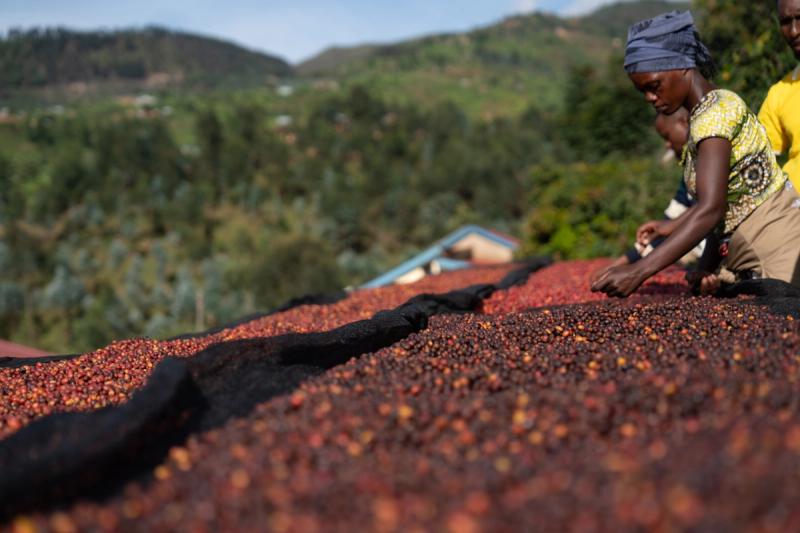
Photo below: Gitesi Coffee Washing Station in Rwanda
Gitesi Natural
Gitesi Natural is a Red Bourbon from Gitesi Coffee Washing Station in Rwanda. It has the generous body and jammy red-fruit character many people love in a natural coffee, alongside gentle acidity that keeps the cup approachable.
Gitesi is a washing station, a name that might sound surprising for a natural coffee. But a washing station can process coffee in more than one way. The natural lot gives the team a chance to work with ripe cherries from its own farm and create a fuller, more fruit-led expression than the washed Gitesi coffees.
Try it when you want a coffee with depth and texture: one that feels a little closer to berry compote than fresh citrus, without losing the clarity to be enjoyable cup after cup.
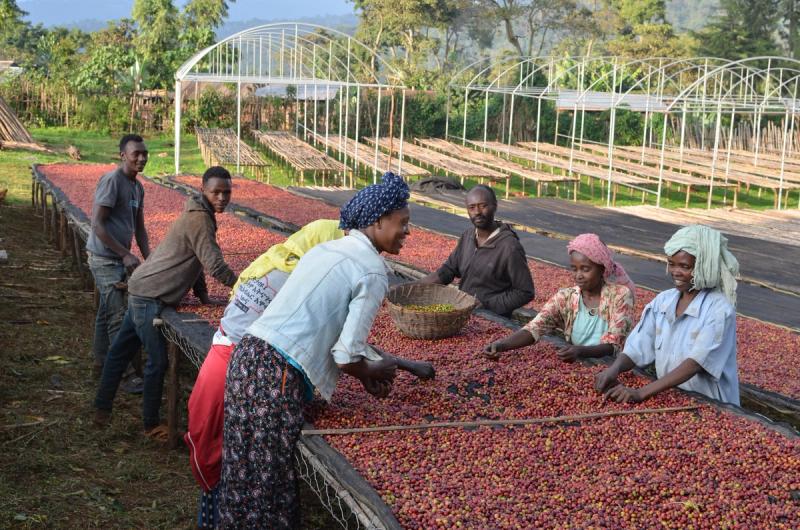
Photo below: Workers sort coffee at Lensa Gari Washing Station in Ethiopia.
Lensa Gari
Lensa Gari is a natural coffee from the Guji zone of Ethiopia. Here, natural processing meets one of coffee’s most aromatic landscapes. Expect vivid berry fruit with a floral lift, a cup that can feel both juicy and elegant at once.
It is a useful counterpoint to Gitesi Natural. Where Gitesi Natural leans toward a fuller, jammy red-fruit profile, Lensa Gari brings a more lifted, fragrant expression. Put the two side by side and the point becomes clear: natural processing can amplify fruit, but origin and variety still decide what kind of fruit story you taste.
The point is not to expect one flavor
When you see natural process on a coffee bag, you know the whole cherry dried around the seed. That is a useful clue: you may find more ripe fruit, sweetness, and body than in a comparable washed coffee. But it cannot tell you everything about the cup.
The best way to get to know the method is to compare. Brew Gitesi Natural and Lensa Gari side by side. Notice the body, the intensity of the fruit, and the way the flavor changes as the cup cools. One may feel jammy and rounded; the other may feel brighter and more floral. Both are natural coffees, but neither is a template for the other.
Washed, honey, or natural?
After three articles, there is still no winner. There are only different ways of treating the coffee cherry after harvest.
- Washed coffee removes most fruit before drying, often bringing clarity, lively acidity, and defined detail.
- Honey coffee dries with some mucilage left on the seed, often balancing sweetness, texture, and clarity.
- Natural coffee dries inside the complete cherry, often bringing fuller body, ripe fruit, and generous sweetness.
Each can produce an exceptional coffee. The exciting part is tasting how the producer’s decisions show up in the cup. Start with the coffees you know, then use the processing information on the bag as an invitation to notice something new.