Honey-Processed Coffee: What It Is, Why Producers Choose It, and What It Tastes Like
Honey-processed coffee contains no honey. Instead, some fruit mucilage remains on the seed as it dries, often creating a sweet, rounded, and expressive cup. Learn how the process works with three Warawul examples.

Honey-processed coffee sounds as though somebody added honey to the beans. They did not.
The name comes from the sticky, honey-like layer of fruit that remains around the coffee seed after the cherry has been depulped. Instead of washing that layer away completely, as in washed processing, the producer leaves a chosen amount of it on the coffee during drying.
That small decision can make a big difference in the cup. Honey processing often brings together some of the clarity associated with washed coffee and some of the sweetness and body associated with natural processing. But it is not a halfway point or a shortcut. It is its own method, and it demands close attention from the moment the cherries arrive.
This is part two of our series on coffee processing. In part one, we explored washed coffee. Next, we will look at natural processing.
What is honey-processed coffee, and how is it processed?
A coffee cherry is a fruit, and the seed inside it is what eventually becomes the coffee we roast. Around that seed are several layers: skin, pulp, a sticky sugary layer called mucilage, and parchment.
With honey processing, the cherry skin and pulp are removed after harvest, but some of the mucilage stays attached to the parchment coffee while it dries. The amount left on the seed, together with the way it is dried, is part of the producer’s intended process.
The broad sequence usually looks like this:
- Picking and sorting: Ripe cherries are harvested and sorted. Starting with sound, ripe fruit is essential because the fruit remains involved in the process after depulping.
- Depulping: A machine removes the outer skin and most of the pulp. Unlike washed processing, the coffee is not then fully cleaned of its sticky mucilage.
- Retaining mucilage: The producer decides how much mucilage to leave on the parchment. This is one of the variables that shapes the drying behaviour and, ultimately, the cup.
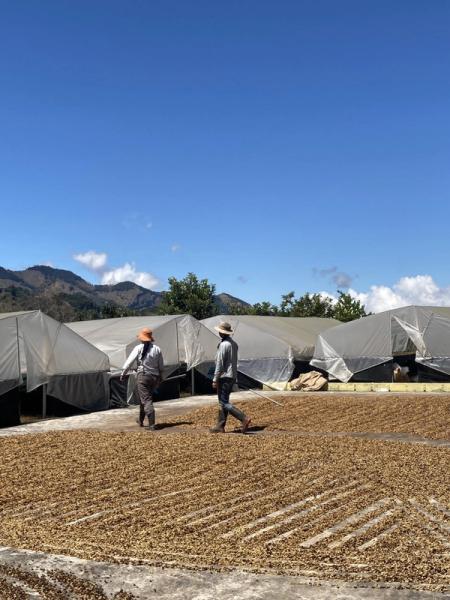
- Drying: The parchment coffee is spread on patios or raised beds and moved regularly. The mucilage is rich in sugars, so the drying pace, airflow, temperature, and weather need careful management.
- Resting and milling: Once the coffee has dried to a stable level, it rests before the parchment layer is removed later in the process.
You may see names such as yellow honey, red honey, or black honey. These often refer to the amount of mucilage retained, the pace and conditions of drying, or the colour the coffee takes on while it dries. There is no universal rulebook, though. A red honey from one producer is not automatically the same process as a red honey from another, and the names are not a ranking from good to better.
Honey processing is often described as sitting between washed and natural coffee. That comparison can be useful at first, but it only goes so far. In a washed coffee, the fruit is mostly removed before drying. In a natural, the whole cherry dries around the seed. Honey processing begins after depulping, but it keeps a deliberate amount of the fruit’s sticky layer in the story.
Why do producers choose honey processing?
Honey processing gives producers a way to influence how much fruit character stays with the coffee during drying. By leaving mucilage on the parchment rather than washing it all away, they can build sweetness and texture while still allowing the variety and place of the coffee to remain recognisable.
That balance is one reason the method is so compelling. A well-managed honey coffee can be fruit-forward without becoming heavy, sweet without becoming one-note, and full-bodied while still feeling clean.
It is also a hands-on method. Coffee covered in mucilage cannot simply be laid out and forgotten. The drying coffee needs to be monitored and moved so that it dries evenly. Humidity, sun, airflow, and the amount of mucilage all affect the pace. If drying is too slow or uneven, defects can develop. If it moves too quickly, the result may not have the structure the producer intended.
For producers who work with honey processing year after year, those decisions are part of a refined craft, not a recipe copied from somewhere else. The method responds to local weather, available drying space, the variety being processed, and the flavour the producer wants to build.
What does honey-processed coffee typically taste like?
Processing is only one part of why a coffee tastes the way it does. Variety, soil, elevation, weather, fermentation, drying, roasting, and brewing all shape the final cup. Still, honey-processed coffees often share a few tendencies:
- Rounded sweetness: Think honey, brown sugar, toffee, ripe fruit, or jam, depending on the coffee.
- More body and texture: Many honey coffees feel silkier or more syrupy than a typical washed coffee.
- Expressive fruit: Fruit notes can be generous and ripe, but often remain more defined than in a heavily fruit-driven natural.
- Balanced clarity: A good honey coffee can keep a clear finish and a readable sense of place alongside its added sweetness.
None of these are guarantees. Honey processing is not an instruction to expect sweetness alone. The same method can produce an elegant, floral coffee, a rich chocolate-and-fruit espresso, or something bright and juicy. That variation is exactly the point.
Taste honey processing across our coffee menu
Our honey-processed coffees show how broad the category can be. They come from different producers, countries, and varieties, but each uses retained mucilage to bring a particular kind of sweetness and texture into focus.
Foto below: Producers Arleen and Maria Jimenez work with honey-processed coffees in Costa Rica
Angostura Espresso
Angostura Espresso is a honey-processed Caturra coffee from Arleen and Maria Jimenez. It shows why honey processing can work beautifully in espresso: the cup has a round, silky feeling without losing definition. We find peach, nougat, and brown sugar, a combination that is sweet and structured rather than simply heavy.
It is a useful reminder that a honey coffee does not have to be reserved for filter brewing. In espresso, the extra sweetness and body can make a coffee especially satisfying on its own and resilient enough to hold its character in milk.
Pimienta Honey
Pimienta Honey is our opportunity to taste honey processing through a rare Colombian variety: Bourbon Pimienta. The variety is already expressive. The honey process gives that character a little more texture and sweetness while keeping the coffee’s finer details in view.
This is where honey processing becomes particularly exciting: it does not cover up the identity of the coffee. Managed well, it can give a distinctive variety more room to be itself.
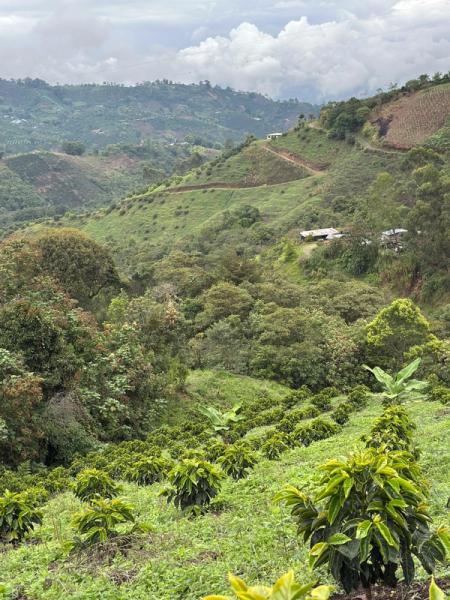
Photo below: Located at nearly 2,000 masl, Finca Bella Vista’s altitude requires José del Mar to take even more care in the drying of his honey-processed coffees.
Bella Vista, Pink Bourbon Honey
Bella Vista is José del Mar Ordoñez’s Honey Pink Bourbon from San Agustín in Huila, Colombia. We have returned to this coffee for a second harvest because it is such a clear expression of what a careful honey process can do. We taste citrus at the start, apricot through the middle, and soft toffee in the finish.
Pink Bourbon is known for its expressive aromatics, and Bella Vista shows how the honey process can support that character rather than blur it. The coffee remains floral and bright, but it also has the sweetness and rounded shape that make honey coffees so inviting.
The point is not to expect one flavour
When you see honey process on a coffee bag, it tells you that some mucilage remained with the seed during drying. That is a useful clue: there may be more sweetness, body, or ripe fruit in the cup than you would expect from a comparable washed coffee.
Next in the series: natural processing, where the whole coffee cherry dries around the seed and fruit influence takes on an even bigger role.