What Is "Blooming" and Why Does It Matter for Pour-Over?
That bubbling dome of coffee grounds in the first seconds of a pour-over isn't just for show. We explain the CO2 science behind the bloom, walk through how to do it properly on a V60 or Aeropress, and show you how to read your own bloom as a real-time freshness check.

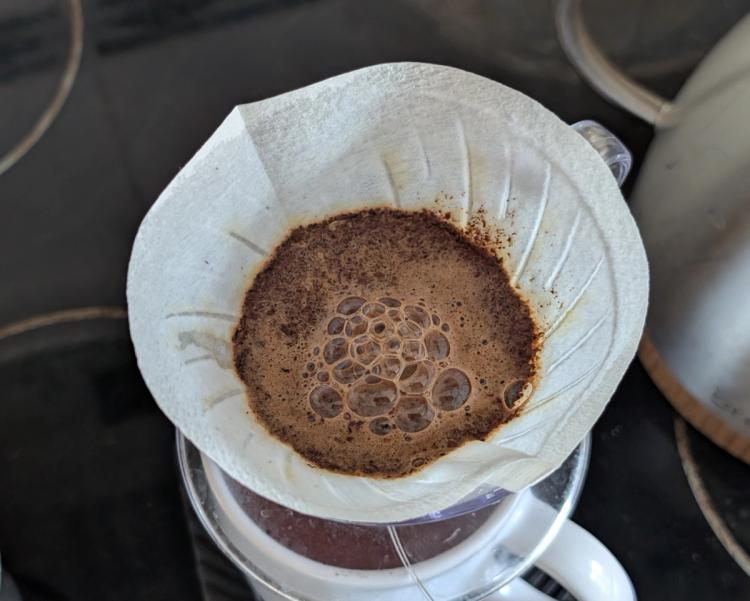
If you've ever watched someone make a V60 in a café, you've seen it: the first splash of water hits the grounds, and the whole bed puffs up into a little bubbling dome, like it's breathing. Baristas call this the bloom, and it's one of those small moments that looks like ceremony but is actually pure chemistry, and a genuinely useful signal about the coffee in your cup.
Here's what's happening, why it matters, and how to do it properly at home.
Why coffee grounds "bloom" in the first place
Roasting doesn't just change a bean's colour and flavour — it also traps gas inside it. As beans roast, they develop tiny internal pockets that fill mostly with carbon dioxide (CO2), a natural by-product of the roasting reactions. That CO2 doesn't disappear when the roast ends; it stays locked inside the bean and slowly leaks out over the following days and weeks, a process called degassing.
The moment hot water hits freshly ground coffee, it rushes into those gas pockets and pushes the trapped CO2 out all at once. The gas has to escape somewhere, so it pushes up through the wet grounds — and that's your bloom.
Two things make the bloom bigger and more dramatic:
- Fresh beans. The closer you are to roast date, the more CO2 is still trapped inside, so the bloom is bigger and more active.
- Fresh grinding. Whole beans hold onto gas for a long time because so little surface area is exposed to air. The second you grind, you multiply that surface area, which is also why we always recommend grinding right before you brew rather than buying pre-ground.
Why the bloom actually matters for your cup
It's not just a nice visual — skipping it changes how your coffee tastes.
If you pour your full brewing water straight onto dry, gassy grounds, that escaping CO2 gets in the way of extraction. Bubbles cling to the coffee particles and repel water, which can cause channeling: water finds the path of least resistance through the coffee bed instead of passing evenly through all the grounds. The result is uneven extraction — some grounds over-extracted and bitter, others under-extracted and sour or thin.
Blooming first lets most of that gas escape before the real extraction starts, so when you do your main pour, water can actually reach and dissolve the flavour compounds evenly instead of fighting bubbles. Think of it as clearing the room before the real conversation starts.
How to bloom a V60
- Rinse your filter and add your ground coffee, then give the dripper a gentle shake to level the bed.
- Start your timer and pour water evenly over all the grounds — roughly 2 to 3 times the weight of your coffee dose (so about 40–60g of water for 20g of coffee). Spiral outward from the centre and make sure there are no dry pockets left.
- Watch the bed rise into a dome and bubble. If you like, give it one gentle stir or swirl to release any trapped pockets at the edges — optional, and mostly down to preference.
- Let it sit for 30–45 seconds, then continue with your main pour in your usual pulses.
How to bloom an (inverted) Aeropress
The principle is identical, just the geometry is a bit different. The shape of the Aeropress is more akin to a long cup. Here's how we brew it at warawul:
- Add 15g coffee grounds.
- Add 50g water. Stir gently. Freshly roasted, freshly ground coffee will expand for around 30 seconds.
- At 30-45 seconds, pour the remaining water (250g total). Stir again. Place cap with paper filter.
- At 2 minutes and 15 seconds, flip the Aeropress and plunge slowly.
How long should you let it bloom?
30–45 seconds is the sweet spot for most home setups. As a rough guide:
- If the bed is still visibly puffing and bubbling past 30 seconds, give it another 5–10 seconds.
- If it's already flattened out, there's no benefit to waiting longer — start your main pour.
- Very long blooms (over a minute) don't extract more; they just mean your coffee is sitting in contact with water without the flow that pulls flavour through evenly.
Reading your bloom: a built-in freshness check
Here's the part most people miss: your bloom is telling you something about the coffee itself.
- A big, domed, actively bubbling bloom is a good sign — it usually means the beans are close to roast date and were ground shortly before brewing.
- A flat, quiet bloom with barely any rise usually means the beans have lost most of their CO2, either because they're past their best, or because they sat ground for a while before brewing. It doesn't automatically mean the coffee is undrinkable, but it's a signal that you're not tasting it at its peak.
Freshness is the biggest lever you have over how your coffee tastes at home, and the bloom is the easiest way to see it in action, cup after cup.
Quick recap
- The bloom is trapped CO2 escaping when water hits freshly roasted, freshly ground coffee.
- Skipping it can cause channeling and uneven extraction.
- Use roughly 2–3x your coffee's weight in water, wet everything evenly, and let it rest 30–45 seconds before your main pour.
- A big bloom = fresh coffee. A flat one = time to check your roast date, or just enjoy it and take note for next time.
Next time you brew, actually watch the bloom instead of walking away to warm your cup. It only lasts half a minute, but it tells you almost everything you need to know about what's in your filter.