How to Read a Coffee Bag: What Actually Matters Before You Buy
A pretty bag doesn't mean good coffee. Here is a practical checklist for reading a coffee bag before you buy: roast date, origin, farm, processing, grind, flavor notes, valve, and blend versus single origin, plus why we think processing shapes flavor as much as elevation does.

There are a lot of beautifully designed coffee bags out there, and the nicest label rarely tells you anything about what's inside. The good news is that the real quality signals are usually printed right on the bag too, you just need to know where to look. Here is our checklist for reading a coffee bag before you buy, plus one point where we quietly disagree with the conventional wisdom.
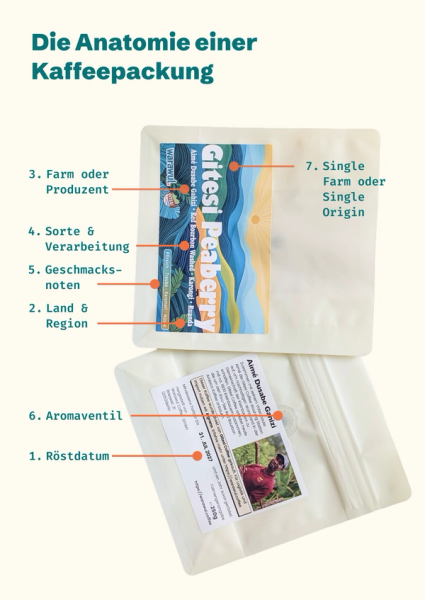
1. Roast date
Look for a "roasted on" date, not a "best before" date. Our bags include a combination of both, with the phrasing "Best before [date] and roasted one year prior." Conventional wisdom is that lightly roasted coffee tastes best within two to four weeks of roasting. If the coffee is not pre-ground and the bag is left unopened and stored in dry conditions away from light and humidity, that freshness window can stretch a bit longer. We've also taste-tested our whole bean coffees a 4-5 months after the roast date and found that while the flavors and aromas might have dimmed a bit, the coffee was still tasty and any difference was not enough reason to throw the coffee out. Once the coffee bag is open, we do recommend consuming within a few weeks.
2. Country and region
At a minimum, a bag should tell you where the coffee was grown. Origin alone gives you a rough idea of what to expect: Ethiopian coffees often lean floral and tea-like, Colombian lots tend toward balanced sweetness, Rwandan coffees from washing stations like Gitesi are typically clean with citrus and stone fruit. Region narrows that picture further, since a coffee from Huila will taste different from one grown in Santander even within the same country. Our bags list both region and country along with traceability info down to the farm.
3. Farm or producer
Specialty roasters usually go one step further than country and region: the cooperative, the washing station, the individual farm, sometimes the name of the person who grew it. Naming the producer doesn't guarantee quality by itself, but a coffee that is traceable to one farm or one washing station is far more likely to have been handled carefully at every step, and far more likely to have been bought directly or fairly. That's why our bags carry names like José del Mar Ordoñez, whose Pink Bourbon Honey we roast as Bella Vista, or Arleen and Maria Jimenez at Beneficio La Angostura in Tarrazú, or Moisés Hidardo Hernández, whose fermented lots became Cascaritas Barolo and Cascaritas Chardonnay. It's also why we publish a full transparency report showing what we actually pay for green coffee.
4. Processing
The bag should tell you how the coffee was processed, whether that's washed, natural, honey, or something more experimental like anaerobic or yeast fermented. Processing gives real clues about the flavor you'll get, and it also tells you something about the care taken between harvest and drying. Our own lineup runs the full range: Gitesi Espresso is washed and clean, Gitesi Natural is dried whole in the cherry for heavier body and fruit, and El Mandarino is an anaerobic natural Parainema from Rosy Dariela Mancía in Honduras with a much wilder fruit profile. We say more about why processing matters so much further down.
5. Flavor notes
Tasting notes like "bergamot, dried apricot, toffee" are partly marketing, and you shouldn't expect to taste a fruit bowl in your cup. What they're useful for is calibrating expectations: a coffee described as bright and floral will behave differently in your kettle than one described as chocolatey and heavy, and that's worth knowing before you buy a whole kilo. Read them as a general steer, not a guarantee.
6. One-way valve
This one isn't printed on the bag, it's built into it, and it matters more than most people realize. Freshly roasted coffee releases CO2 for days after roasting. A one-way valve lets that gas escape without letting oxygen in, which is what keeps the coffee's aroma intact instead of going stale or, worse, exploding a sealed bag on the shelf. If a bag doesn't have one, be skeptical of how it was packed.
7. Blend or single origin
Coffee bags should say whether the coffee is a blend or comes from a single farm or a specific cooperative. Some roasters treat blends as a cost-saving mechanism, mixing lower priced, sometimes lower quality lots into roasts with the broadest possible appeal and highest margins. We exclusively roast single farm and single origins coffee as we feel this is how we can best honor the work that went into creating the high quality coffees we buy. Even Gitesi Gold, a deliberately dark, punchy coffee built for milk drinks, is a blend of washed and natural coffees from a single washing station. If you don't know a roaster yet, a single origin is the safer way to judge what they're actually capable of - with no blend to hide behind.
Another detail: Whole bean or ground
Many coffee bags will also say whether the coffee is whole bean or ground. Coffee starts losing aroma the moment it's ground, so buy whole bean and grind only right before brewing. At Warawul, we sell whole beans as the default. But we can also grind your beans to order for a pre-selected brewing method. For example, Moka pot or French Press. If you want the details on why grind size matters and how to dial it in for your brew method, we've written a full guide to that separately.
What about elevation?
Most buying guides put elevation right at the top of the checklist. The logic is as follows: at higher altitude, cherries ripen more slowly in the cooler air, which gives the bean more time to build up sugars and develop flavor. Very roughly, buying guides sort likely flavors by altitude, from earthier and more muted at low elevation to fruity and floral above roughly 1,500 meters above sea level. For a lot of roasters, elevation is still treated as a quick proxy for quality.
Here's where we differ a little. In our own cupping and sourcing, we've seen just as much flavor variation driven by processing and fermentation as by elevation, sometimes more. Two lots from the same farm, at the same altitude, can taste completely different depending on how long they ferment, whether that fermentation happens with the fruit still on the bean or after it's removed, what yeasts or cultures are involved, and how carefully drying is managed afterward. In the Boss Barista interview with fermentation specialist Lucia Solis, a former winemaker who now works directly with producers in Guatemala, she makes the case that fermentation is one of the most powerful and most underused tools producers have for shaping flavor and improving consistency, independent of what the land itself gives them.
Our own Cascaritas Barolo is a good example: it's grown at a fairly ordinary elevation for Honduras, but the cherries are inoculated with Barolo wine yeast and dried whole, which is what actually gives the cup its unique character, not the meters above sea level. So look at elevation if it's on the bag, it's a reasonable data point, but don't let it override what the processing description is telling you. A well-managed natural or co-ferment at moderate altitude can easily out-taste a washed coffee grown high up but processed without much care.
The quick version
Before you buy your next bag, check for a roast date, country and region, the farm or producer if it's listed, how it was processed, that it's whole bean, a one-way valve, and whether it's a blend or single origin. Read the flavor notes as a rough guide, and take elevation as one signal among several rather than the deciding one. Every Warawul bag is built to pass this checklist, so next time you're in our Neukölln café or browsing the shop, you'll know exactly what you're looking at.